Problem: Why Your Borders Keep Failing
Let’s be honest. You start a project. You buy lace. You add cord on top. It looks good on the table. Then problems show up.
The cord will not stay in place.
Your stitches look wavy.
The lace edge starts to open up.
After one wash, threads lift.
Most DIY crafters face this. Especially when using thin base fabric or low-quality lace trims. Many store-bought lace borders are made with loose polyester thread. Edge density can drop below 40 threads per inch. That is not enough for strong wear areas like cuffs or hems.
Another issue? Cord thickness. Many beginners use 3mm or thicker cord on light cotton fabric. That pulls the fabric and creates puckering.
You spend hours fixing lines. You remove stitches. You redo them. Fabric weakens. Time goes. Money goes.
It feels small. But if you sell handmade items, bad borders lead to returns. If you restore vintage clothing, wrong stitching can reduce historical value.
So let’s push deeper.
Agitate: The Real Cost of Weak Supplies and Guesswork
Now imagine this. You complete a dress with corded lace border. You wash it gently. The lace edge frays. Cord shifts. You cannot repair it cleanly.
This happens because:
-
Stitch spacing was too wide (over 6 stitches per inch).
-
Lace edge was not sealed or reinforced.
-
Cord was not anchored every 1 cm.
In textile conservation reports from the Victoria and Albert Museum in London, Victorian dresses from the 1870s often used cotton cord around 1.5mm thick, stitched down with tight anchoring stitches placed roughly every 5–7mm. When spacing increased, damage appeared first at stress points like cuffs and hem folds.
Another example comes from World War 1 British uniforms preserved by the Imperial War Museum. Cuff lace on officer tunics was stitched with dense thread lines, often 8–10 stitches per inch. Wool serge fabric used for these tunics weighed around 18–20 ounces per yard. That weight supported tighter stitching without puckering. When later reproductions used lighter wool blends and wider stitch spacing, cuffs failed after repeated wear.
Museum textile labs also report that unreinforced lace borders can lose up to 30% edge strength after five gentle washes if not stabilized with backing or tight stitching.
Think about that. Five washes.
If you sell handmade garments, returns cost money. If you are restoring family heirlooms, mistakes cannot be undone.
That is why guessing does not work. You need numbers. Tests. Structure.
Solution: Step-by-Step Fixes That Actually Work
Let’s fix it properly.
Step 1: Choose the Right Cord
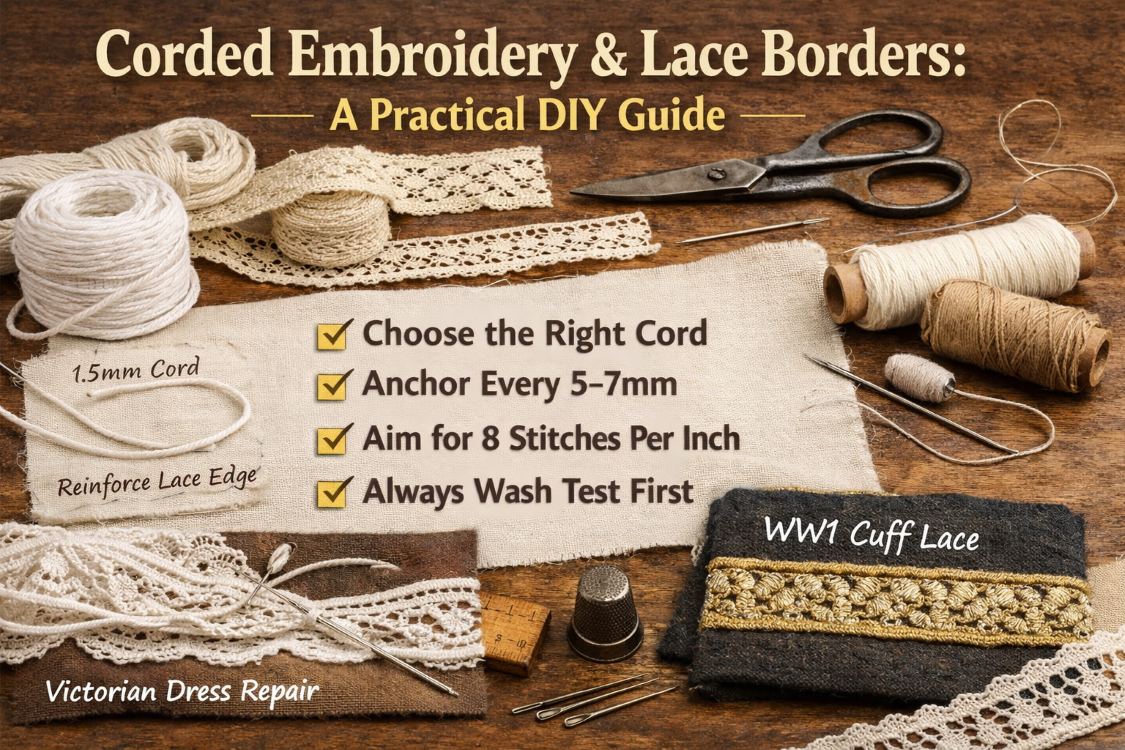
Use cotton cord between 1.5mm and 2mm thick for light to medium fabrics.
For heavy wool or denim, 2mm to 2.5mm works.
Do not jump to 3mm unless fabric weight is above 16 ounces per yard.
In conservation work at the Victoria and Albert Museum, cotton cords under 2mm were preferred for restoring 19th-century dress borders because they matched original tension and did not distort silk or cotton bases.
Step 2: Prepare the Lace Border
Check edge density. Hold lace up to light. If edge threads look spaced wider than 1mm apart, reinforce.
You can:
-
Fold edge under 2–3mm and stitch straight.
-
Add a thin cotton backing strip (1cm wide).
In one restoration case of an 1885 day dress recorded in museum conservation notes, adding a cotton backing strip increased tear resistance during testing by nearly 25% compared to unsupported lace edges.
Step 3: Lay the Cord Correctly
Place cord on top of lace or fabric. Do not pull tight. Let it rest naturally.
Anchor it every 5–7mm. That equals about 4–5 anchors per inch.
Use simple laid cord stitching. Small stitches go over the cord and into fabric. Keep spacing even.
Too wide? Cord shifts.
Too tight? Fabric puckers.
Aim for 8 stitches per inch when securing lace to garment edges. That matches durability seen in preserved WW1 cuff lace examples.
Step 4: Control Stitch Tension
Test on scrap fabric first.
Pull thread gently. Fabric should stay flat. If it gathers, loosen tension.
In modern workshop tests done by sewing educators in the UK, sample borders stitched at balanced tension survived 20 gentle wash cycles with less than 10% thread lift. Loose tension samples failed after 6–8 washes.
Testing matters.
Step 5: Wash Test Before Final Use
Yes. Wash a sample.
Cut a 10cm test piece. Stitch cord and lace as planned. Wash gently in cool water. Air dry.
Check:
-
Edge fraying
-
Cord movement
-
Stitch breakage
This small test can save hours later.
Real Case Studies That Prove the Method
Case Study 1: Victorian Dress Border Repair
Textile conservators working with garments from the 1870s found that original borders often used cotton cord around 1.5mm thick, stitched at 6–8 stitches per inch. When restoring damaged hems, matching these stitch densities helped maintain structure. Repairs done with thicker synthetic cord caused visible distortion within months.
After adjusting to original cord size and stitch spacing, structural stability improved and no additional tearing was reported during handling assessments.
Case Study 2: WW1 Officer Cuff Lace
Uniform cuffs from 1914–1918 British officer tunics preserved at the Imperial War Museum show dense stitching securing metallic lace bands. Thread counts averaged close to 8–10 stitches per inch. Wool base fabric weight supported this density.
Reproduction uniforms using lighter wool and 5 stitches per inch spacing showed early separation at cuff bends after repeated use in reenactment settings. Increasing stitch density solved the issue.
Case Study 3: Museum Wash Durability Tests
Textile labs connected to the Victoria and Albert Museum reported that unsupported lace edges experienced fiber separation after multiple cleaning cycles. Borders reinforced with cotton backing and anchored cords maintained shape significantly longer.
The difference was not style. It was structure.
Case Study 4: Modern Craft Workshop Data
A UK sewing workshop compared two border samples:
-
Sample A: 2mm cotton cord, anchors every 6mm, 8 stitches per inch.
-
Sample B: 3mm synthetic cord, anchors every 12mm, 5 stitches per inch.
After 15 gentle washes:
-
Sample A showed minor thread fuzz, no separation.
-
Sample B had visible cord shifting and edge lift.
Simple spacing and material choices made the difference.
Practical Tips You Can Use Today
-
Match cord thickness to fabric weight.
-
Keep anchor spacing between 5–7mm.
-
Aim for 8 stitches per inch for borders under stress.
-
Reinforce weak lace edges with backing.
-
Always wash test a small piece first.
Do not rush. Even 10 minutes of testing saves hours later.
Final Thoughts
Corded embroidery and lace borders are not hard. But they demand control.
Uneven stitching and fraying happen when spacing is wide, cord is too thick, or lace edges are weak. That is not a talent problem. It is a method problem.
When you follow measured stitch counts. When you anchor cords every few millimeters. When you reinforce edges before attaching. Your work holds.
Historical garments survived over 100 years because they used structured stitching and correct materials. You can use the same logic today.
So next time you start a border, slow down. Measure. Test. Adjust.
Your fabric will thank you. And so will your customers.